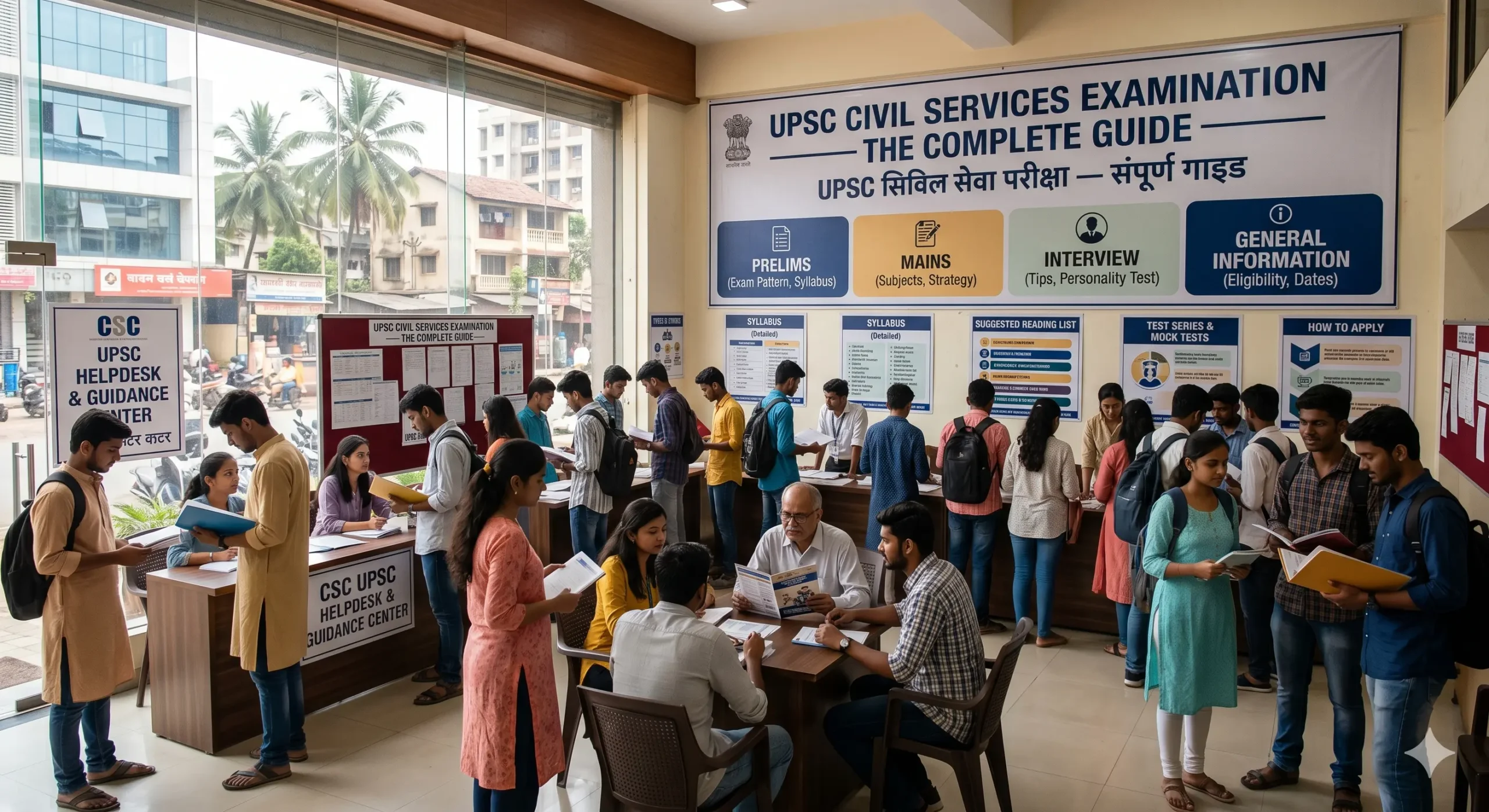
The UPSC Civil Services Examination is the most prestigious, most analyzed, and most discussed competitive examination in India. Conducted annually by the Union Public Service Commission, it recruits officers for the Indian Administrative Service (IAS), Indian Police Service (IPS), Indian Foreign Service (IFS), and over 20 other Group A and Group B Central Services. Every year, approximately 9–10 lakh candidates apply. Fewer than 1,100 are finally selected.
The examination is not merely a test of knowledge. It is a test of analytical ability, communication skills, ethical reasoning, and the capacity to form coherent opinions on complex issues. It demands genuine intellectual engagement with India’s history, society, polity, economy, environment, and the wider world. Toppers consistently say that what UPSC rewards most is not the quantity of information you possess but the quality of thinking you demonstrate.
The three-stage process—prelims, mains, and interview—unfolds over the course of a year. Each stage serves a distinct filtering function, and the skills demanded at each stage are substantially different. Understanding this is the first step toward smart preparation.
Table of Contents
UPSC Civil Services Examination Stage 1: The Preliminary Examination
The preliminary examination consists of two papers, both objective and both carrying 200 marks each. Only GS Paper 1 counts for merit—the CSAT (Paper 2) is purely qualifying, requiring just 33% to pass.
GS Paper 1 covers Indian and World History, Indian and World Geography, Indian Polity and Governance, Economic and Social Development, General Issues on Environmental Ecology, Biodiversity, and Climate Change, and General Science. The paper has 100 questions carrying 2 marks each, with a negative marking of 0.67 marks per wrong answer.
The prelims cutoff for general category candidates typically hovers between 92 and 110 out of 200, depending on the year’s difficulty level. Crucially, prelim marks do not carry forward to the final merit—it is purely a screening gate.
Strategy for Prelims: Solve the last 10–12 years of UPSC. Review prelims question papers thoroughly. The paper has a distinct character—it favours conceptual clarity over rote memorisation, frequently asks questions from unexpected angles, and tests Current affairs from a policy and governance lens rather than a news-headline lens. Practice at least 25–30 full-length mock tests before the actual exam. Maintain accuracy — with a 0.67 negative marking, attempting a question you are genuinely unsure about is statistically harmful.
The CSAT paper tests comprehension, basic numeracy, logical reasoning, data interpretation, and general English. While qualifying in nature, aspirants with weak mathematical or analytical foundations must take it seriously—failing CSAT has eliminated many well-prepared GS candidates.
UPSC Civil Services Examination Stage 2: The Main Examination
The Mains is where UPSC’s depth and breadth truly become apparent. It consists of nine papers: two qualifying (Indian language and English, 300 marks each) and seven merit-ranking papers totalling 1,750 marks. The interview adds another 275 marks, making the total score out of 2,025.
Essay Paper (250 marks): Two essays on topics from a provided list spanning philosophy, ethics, social issues, economy, governance, and abstract themes. Essays are expected to be 1,000–1,200 words each, structured coherently, argued with multiple perspectives, supported with examples, and concluded thoughtfully. Many candidates write factually rich but structurally weak essays—examiners reward balance, originality, and clarity of thought.
GS Paper 1 (250 marks): Indian Heritage and Culture, History of the World and Society, and Post-Independence India. Important areas include art and culture, the freedom struggle, post-independence consolidation, world history from the 18th century, and social issues like poverty, urbanization, and women’s empowerment.
GS Paper 2 (250 marks): Governance, Constitution, Polity, Social Justice, and International Relations. This paper demands not just knowledge of constitutional provisions but critical analysis of governance failures, institutional design, welfare schemes, and India’s foreign policy.
GS Paper 3 (250 marks): Technology, Economic Development, Agriculture, Environment, Biodiversity, Disaster Management, and Internal Security. This paper rewards candidates who follow economic policy closely and understand the science behind environmental and technological issues.
GS Paper 4 — Ethics (250 marks): This is UPSC’s most unique paper. It tests ethical theory, values in public life, emotional intelligence, attitude, and aptitude and, through case studies, tests your practical application of ethical principles to administrative dilemmas. Many candidates who are strong in all other GS papers underperform in ethics due to poor case study writing—this is an area where structured practice pays enormous dividends.
Optional Subject (250 + 250 = 500 marks): The optional subject is among the most consequential choices in the UPSC journey. High-scoring optionals in recent cycles include PSIR (Political Science and International Relations), anthropology, geography, sociology, and public administration. However, the best option for you depends on your academic background, genuine interest, coaching and material availability, and recent trends in examiner expectations.
UPSC Civil Services Examination Answer Writing: The Core UPSC Skill
Answer writing in UPSC Mime has a structure that must be learned and practiced deliberately. Every answer should have three elements: an introduction that defines the context and scope of the question; a multi-dimensional body that covers different aspects—historical, economic, social, political, and environmental—as relevant; and a balanced conclusion that is forward-looking rather than declaratory.
Examiners evaluate answers on introduction quality, coverage of dimensions, use of examples and data, balance between perspectives, and presentation. A well-structured answer with moderate content will consistently outscore a content-rich but poorly structured one.
Practice writing at least one answer per day from the very beginning of your Mains preparation—not after “completing the syllabus.” Join a test series that provides detailed written feedback, not just marks.
UPSC Civil Services Examination Stage 3: The Personality Test (Interview)
The UPSC interview is a 30–45 minute conversation with a board of 5 members. It assesses your personality, intellectual curiosity, communication skills, social traits, integrity, and potential to handle the demands of the civil services. It is not a knowledge test.
Prepare your detailed application form with care—everything you write on it (hobbies, work experience, optional subjects, hometown, educational background) is a potential question thread. Be honest, be yourself, and above all, demonstrate the ability to think on your feet rather than reciting prepared answers.
Be current on issues related to your home state, your academic background, and national and international affairs. When you do not know an answer, saying so honestly and offering a reasoned guess is always better than bluffing.
UPSC Civil Services Examination: Recommended Resources
For History: Bipin Chandra’s Modern India and NCERT books. For Polity: M. Laxmikanth’s Indian Polity (essential). For Geography: NCERT Geography series. For Economy: Ramesh Singh’s Indian Economy and the Economic Survey. For Environment: Shankar IAS Academy’s Environment and Ecology notes. For Ethics: Lexicon for Ethics by Chronicle Publications. For current affairs: The Hindu newspaper (daily) and monthly compilations by Vision IAS or Insights IAS.
UPSC Civil Services Examination: How Many Attempts Does It Take?
The honest answer: most successful candidates are clear in their second or third attempt. The first attempt teaches you the exam’s character—something no book or coaching class fully captures. The second attempt shows you what focused, refined preparation looks like. Use every attempt — whether successful or not — as structured feedback. The candidates who finally succeed are almost always those who changed their strategy rather than simply studied harder.

Amita Gavas believes in empowering students with the right knowledge and guidance so they can confidently prepare for exams and secure a stable government career.