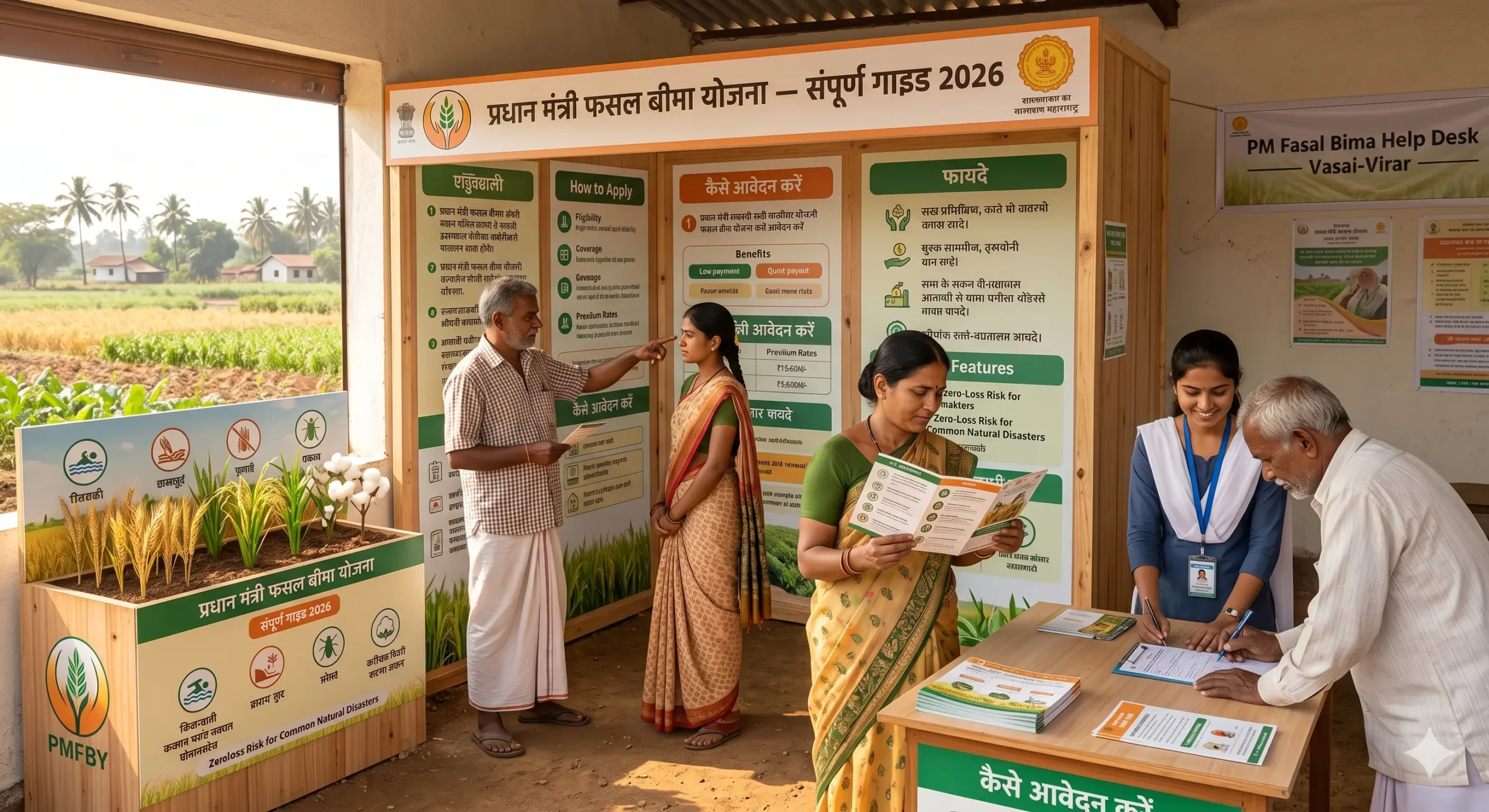
PM Fasal Bima Yojana 2025: Farming in India has always been a gamble against nature. A good monsoon brings prosperity; a drought, flood, or pest attack can wipe out an entire crop and push a family into debt for years. For India’s 14 crore farming families, the risk of crop failure is not just an economic problem—it is an existential one.
The Pradhan Mantri Fasal Bima Yojana (PMFBY) was designed to protect farmers from this uncertainty. Launched on February 18, 2016, PMFBY is a crop insurance scheme by the Department of Agriculture, Cooperation, and Farmers’ Welfare, Ministry of Agriculture. It aims to provide financial protection to farmers against crop loss due to natural disasters, pests, and diseases and operates under the “One Nation, One Crop, One Premium” motto.
Today, PMFBY is deemed to be the largest crop insurance scheme in the world in terms of farmer enrolments and the third-largest in terms of insurance premiums. In 2025, with a continued government budget and improved technology-driven claim settlements, PMFBY remains the most important safety net for Indian farmers.
Table of Contents
What Is PM Fasal Bima Yojana?
PMFBY is a government-backed crop insurance program that protects farmers from financial losses caused by natural calamities, pests, and diseases. Farmers pay a very low, subsidized premium—the rest is borne by the central and state governments—and receive compensation when their crops are damaged or destroyed.
PMFBY replaces three older crop insurance initiatives—the Modified National Agricultural Insurance Scheme (MNAIS), the Weather-based Crop Insurance Scheme, and the National Agricultural Insurance Scheme (NAIS)—by incorporating their best features and removing inherent shortcomings.
Key Benefits of PM Fasal Bima Yojana
1. Very Low Premium for Farmers
Under PMFBY, farmers pay 2% of the sum insured for Kharif crops and 1.5% for Rabi crops. For commercial and horticultural crops, the premium is 5%. The balance premium — which can be 50–80% of the actuarial rate — is shared equally between the central and state governments.
2. Comprehensive Risk Coverage
PMFBY covers a wide range of risks:
- Pre-sowing losses — when farmers cannot sow due to insufficient rainfall or other adverse conditions
- Standing crop losses—due to flood, drought, hailstorm, cyclone, pest attack, or disease
- Post-harvest losses — damage to harvested crops kept in the field for drying, caused by unseasonal rains
- Localized calamities—hailstorm, landslide, inundation affecting specific farms
3. Technology-Driven Rapid Assessment
PMFBY integrates advanced technologies like satellite imagery, drones, and mobile apps for precise estimation of crop loss, ensuring accurate claim settlements. This dramatically reduces the time between crop loss and compensation.
4. Direct Bank Credit
Farmers who had successfully enrolled under PM Fasal Bima Yojana and whose crop loss claims were approved are now receiving insurance compensation directly in their linked bank accounts using DBT (Direct Benefit Transfer), without middlemen.
5. Penalty for Late Claims
In a significant farmer-friendly update, from Kharif 2024, a penalty of 12% per annum is automatically applied if there is any delay in claim payment to farmers. This ensures insurance companies prioritize timely settlements.
Crops Covered Under PM Fasal Bima Yojana
The list of notified crops includes food crops (cereals, millets, and pulses), oilseeds, annual commercial crops, and annual horticultural crops. Specific crops are notified by each state government for each season and each district.
Common crops covered include paddy (rice), wheat, maize, bajra, jowar, arhar (tur), moong, urad, cotton, sugarcane, potato, onion, groundnut, soybean, mustard, and many more.
Eligibility Criteria
PMFBY includes land-owning and tenant farmers (per state policy) with insurable crops in notified areas. Exclusions cover institutional landholders, high-income taxpayers, and others as per state rules.
- All loanee farmers (who have taken crop loans from banks) are automatically enrolled unless they opt out
- The scheme is optional for non-loanee farmers. Farmers must have an insurable interest in the insured crops and must possess a valid and authenticated land ownership certificate or a valid land tenure agreement.
- Tenant/sharecropper farmers are also eligible as per each state’s policy
How to Enrol for PM Fasal Bima Yojana
For Loanee Farmers
If you have taken a crop loan (Kisan Credit Card or agricultural loan) from a bank, you are automatically enrolled in PMFBY unless you actively opt out. Your premium is deducted from your loan account.
For Non-Loanee Farmers
- Visit the official PMFBY portal: pmfby.gov.in
- Register with your mobile number and Aadhaar card
- Select your state, district, and crop
- Enter land details (survey number/khasra number)
- Pay the subsidised premium online
- Alternatively, enrol at your nearest bank branch, Common Service Centre (CSC), or insurance company office
Important Deadlines
- Kharif crops: Enrolment deadline is typically the last week of July
- Rabi crops: The last date for application for Rabi crop insurance has been fixed as December 31, 2025, for the current season.
Latest Update: PM Fasal Bima Yojana 2025
In January 2025, the Union Cabinet approved the continuation of PMFBY till 2025–26 with a total budget of ₹69,515.71 crore.
Under the Union Budget 2025–26, the government allocated ₹12,242 crore (US$1.43 billion) for the crop insurance scheme. Over 4 crore farmers benefited from the scheme in FY24 alone.
In 2025, both Kharif and Rabi 2024–25 claims are being cleared phase-wise, with amounts credited directly without middlemen and SMS alerts being sent to registered mobile numbers.
Additionally, the government has announced an expansion to include crop damage by animals (such as wild boar and nilgai attacks) as a ground for payouts—a long-standing demand by farmers across several states.
How to File a Claim Under PM Fasal Bima Yojana
If your crop has been damaged, here is how to file a claim:
- Report the loss within 72 hours of the damage through:
- The PMFBY mobile app
- The toll-free number: 14447
- Your nearest bank or insurance company office
- The crop insurance portal: pmfby.gov.in
- Provide your enrollment details, survey number, and nature of damage
- The insurance company will conduct a crop-cutting experiment or field verification using satellite imagery, drones, or physical inspection
- PMFBY aims to process claims within two months of the harvest to ensure that farmers get the compensation quickly, preventing them from falling into debt traps.
- The approved claim amount is credited directly to the farmer’s bank account via DBT
Premium Rates at a Glance
| Crop Type | Farmer’s Premium | Government Subsidy |
|---|---|---|
| Kharif (rice, maize, cotton) | 2% of sum insured | 98% of actuarial rate |
| Rabi (wheat, mustard, gram) | 1.5% of sum insured | 98.5% of actuarial rate |
| Commercial/Horticultural | 5% of sum insured | Balance by governments |
How to Check Claim Payment Status
- Visit pmfby.gov.in
- Click on “Application Status” or “Beneficiary List.”
- Enter your state, district, and Aadhaar/bank account number
- Your claim and payment status will be displayed
Frequently Asked Questions (FAQs)
Q1. Is PMFBY mandatory for all farmers? It is mandatory only for loanee farmers (those with crop loans). Non-loaned farmers can enroll voluntarily.
Q2. What if I miss the enrollment deadline? You cannot enroll after the cutoff date for that season. Make sure to enroll before the deadline—Kharif (July) and Rabi (December 31).
Q3. Is there a cap on the sum insured? The sum insured is based on the scale of finance fixed by the district-level technical committee for each crop in each district.
Q4. Can tenant farmers enroll? Yes, tenant and sharecropper farmers cultivating notified crops in notified areas are eligible as per state-specific policies.
Q5. What is the official PMFBY helpline? Call 14447 for all crop insurance queries and claim notifications.
Q6. What is the official website? pmfby.gov.in
Conclusion
The Pradhan Mantri Fasal Bima Yojana is the financial safety net that every Indian farmer deserves. By providing comprehensive crop insurance at a premium as low as 1.5–2%, backed by a ₹69,515 crore government budget, PMFBY ensures that no farmer loses everything because of a natural disaster, a pest attack, or unseasonal rain. With technology-driven claim settlements, DBT-based direct payments, and the new 12% penalty for delayed claims, PMFBY in 2025 is more farmer-friendly than ever. If you are a farmer—whether a loanee or non-loanee—enroll your crops in PMFBY this season and protect the hard work you put into your fields.

Rohanshi Mhatre aims to bridge the gap between government initiatives and citizens by delivering clear, reliable, and easy-to-follow information so that everyone can take advantage of available schemes.