For decades, India’s infrastructure development suffered from one fundamental flaw — silos. The railways ministry built tracks without knowing where the roads ministry was planning highways. Port authorities expanded capacity without coordinating with logistics hubs. Power lines were laid without aligning with industrial corridors. The result was duplication, delays, cost overruns, and a crippling logistics inefficiency that cost India an estimated 13–14% of GDP every year — compared to just 8–10% in developed economies like Germany and Japan.
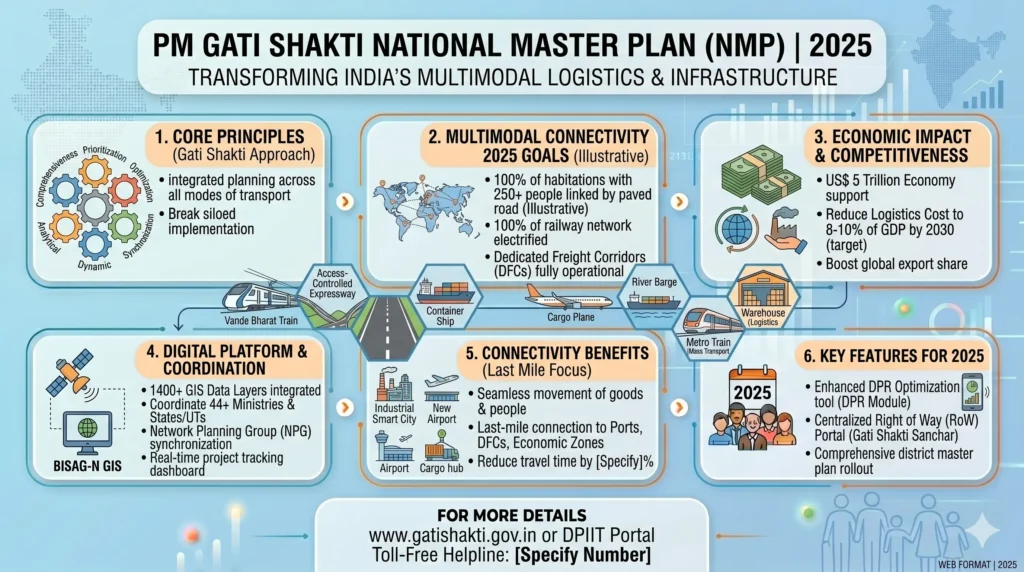
PM Gati Shakti was launched to break these silos once and for all. Announced on August 15, 2021, and launched on October 13, 2021, PM Gati Shakti was conceived as a ₹100 lakh crore national master plan that builds on the ₹110 lakh crore National Infrastructure Pipeline by integrating projects under a common framework — to break silos, cut delays and overruns, and lower India’s high logistics costs. PM UJJWALA YOJANA
It is not just an infrastructure scheme — it is a new way of planning India’s entire physical and social infrastructure, powered by cutting-edge GIS technology and real-time satellite data.
Table of Contents
What Is PM Gati Shakti?
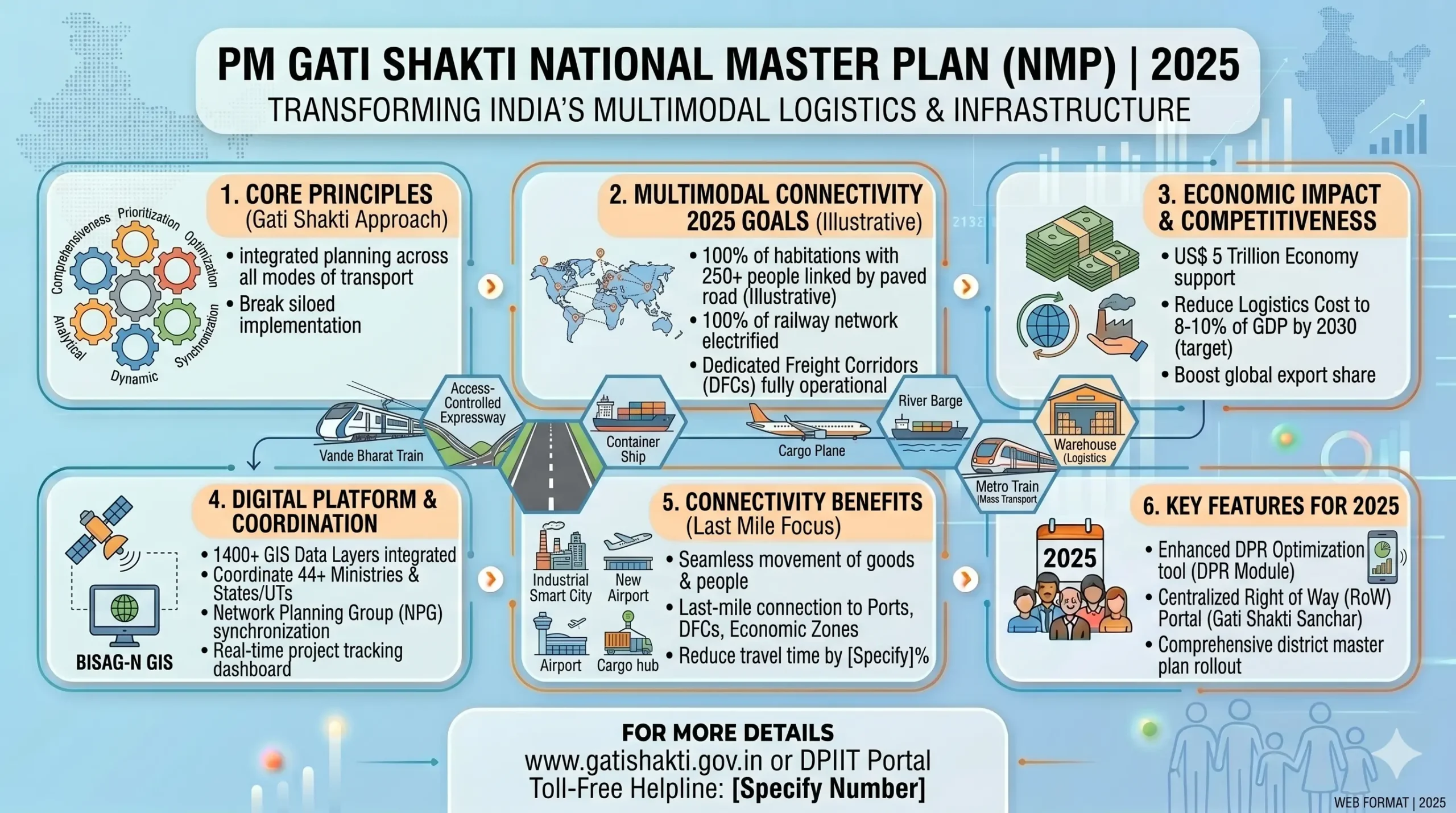
PM Gati Shakti is a ₹100 lakh crore investment initiative for infrastructure development over the next five years. It promotes integrated development across seven economic drivers — railways, roads, ports, waterways, airports, mass transport, and logistics — supported by energy, IT, water, and social infrastructure. zenodo
At its core, PM Gati Shakti is a digital, GIS-based national master plan platform that brings all ministries, departments, state governments, and infrastructure agencies onto a single screen — so everyone can see what everyone else is doing, plan together, and execute without conflict.
The Seven Growth Engines of PM Gati Shakti
PM Gati Shakti operates through seven core infrastructure engines, each representing a critical mode of connectivity:
1. Roads
Highways, expressways, and rural roads that form the backbone of India’s land transport network — linked with PMGSY, Bharatmala, and state road programmes.
2. Railways
Dedicated freight corridors, high-speed rail, metro networks, and station redevelopment — integrated with road and port connectivity.
3. Ports
Major and minor ports expanded with seamless last-mile connectivity to industrial clusters, road networks, and railway freight terminals.
4. Waterways
India’s inland waterway network — rivers and canals — developed as cost-effective freight corridors, particularly for bulk goods.
5. Airports
UDAN scheme regional airports and major international airports connected to ground transport networks and economic zones.
6. Mass Transport
Urban metro networks, RRTS (Regional Rapid Transit Systems), and bus rapid transit systems planned in coordination with road and rail infrastructure.
7. Logistics Infrastructure
PM Gati Shakti will incorporate infrastructure schemes of various Ministries and State Governments like Bharatmala, Sagarmala, inland waterways, dry/land ports, UDAN etc. Economic Zones like textile clusters, pharmaceutical clusters, defence corridors, electronic parks, industrial corridors, fishing clusters, and agri zones will be covered to improve connectivity and make Indian businesses more competitive. Info Gyan99
The GIS-Based Digital Platform — The Heart of Gati Shakti
The technological foundation of PM Gati Shakti is its GIS-based national digital platform, developed by BISAG-N (Bhaskaracharya National Institute for Space Applications and Geo-informatics) using ISRO satellite imagery.
The plan provides the entire data at one place with GIS-based spatial planning and analytical tools having 200+ layers, enabling better visibility to the executing agency. All Ministries and Departments will now be able to visualize, review, and monitor the progress of cross-sectoral projects through the GIS platform, as the satellite imagery will give on-ground progress periodically. Info Gyan99
These 200+ data layers include:
- Existing and planned road, rail, airport, and port networks
- Power transmission lines and pipelines
- Forest areas, water bodies, and protected zones
- Industrial clusters and economic zones
- Social infrastructure like schools, hospitals, and anganwadis
- Population distribution and demographic data
By overlaying all these layers, planners can instantly identify where roads need to be built, where conflicts with forest land exist, where industrial clusters lack rail connectivity, and where social infrastructure is missing — all on a single screen.
Key Features and Achievements
1. Unified Ministry Integration
57 Central Ministries and Departments, including 8 Infrastructure, 22 Social, and 27 Economic and other Ministries/Departments, have been onboarded on the PM Gati Shakti National Master Plan. PMAY-Urban
2. Network Planning Group (NPG)
The mechanism of the Network Planning Group (NPG) has been institutionalised, under which infrastructure projects are evaluated for integrated planning, multimodality, inter-modality, synchronization of efforts, a whole-of-government approach, and last-mile connectivity in and around the project catchment area. So far, 293 infrastructure projects amounting to ₹13.59 lakh crore have been evaluated through the NPG mechanism. PMAY-Urban
3. State-Level Expansion
All States and UTs have developed State Master Plan portals aligned with the National Master Plan; district-level planning has been extended to 28 Aspirational Districts via the BISAG-N-supported District Master Plan portal. Honda Sales Specialist
4. Social Infrastructure Integration
The platform now aids planning for schools, hospitals, anganwadis, and other social facilities, bridging gaps in health, education, and tribal development infrastructure. Five key social sector departments — Health, Education, Rural Development, Women and Child Development, and Housing — are already onboarded. Honda Sales Specialist
5. Private Sector Access
In Union Budget 2025, the Finance Minister announced selective access to PM Gati Shakti portal data/maps for private players to support project planning and PPPs, with DPIIT framing secure-access guidelines for logistics and infrastructure use. PM UJJWALA YOJANA
6. India’s Largest Multimodal Cargo Terminal
On June 17, 2025, Union Railway Minister Ashwini Vaishnaw inaugurated India’s largest automobile Gati Shakti Multi-Modal Cargo Terminal at Maruti Suzuki’s Manesar facility in Haryana — a milestone demonstrating how the initiative is transforming industrial logistics. https://aimindia.in/
Impact on India’s Logistics Competitiveness
Aligned with the National Logistics Policy 2022, PM Gati Shakti has helped improve India’s rank on the World Bank Logistics Performance Index to 38th in 2023, a significant rise from 44th in 2018. zenodo
The initiative is also expected to:
- Reduce logistics costs from 13–14% of GDP to under 10%, saving hundreds of thousands of crores annually
- Cut project delays by eliminating inter-ministry conflicts at the planning stage
- Expedite land acquisition and environmental clearances through upfront GIS-based conflict identification
- Create millions of jobs in infrastructure construction and logistics
Key Targets Under PM Gati Shakti
Development of 11 industrial corridors and two new defence corridors; achieving a turnover of ₹1.7 lakh crore in defence production; development of around 38 electronics manufacturing clusters and 109 pharma clusters; and increasing the total cargo handled at Indian ports to 1,759 MTPA. Mylpg
Frequently Asked Questions (FAQs)
Q1. Is PM Gati Shakti a spending scheme or a planning platform?
It is primarily a planning and coordination platform, not a separate spending scheme. Infrastructure spending happens through individual ministry budgets and the National Infrastructure Pipeline — Gati Shakti ensures they are planned and executed in an integrated, coordinated manner.
Q2. How does PM Gati Shakti reduce project delays?
The coordinated approach under Gati Shakti saves time at multiple stages — planning, approvals, and execution. Ministries no longer work at cross-purposes, meaning fewer project delays due to land acquisition conflicts and overlapping clearances. PM UJJWALA YOJANA
Q3. Can state governments access the Gati Shakti platform?
Yes. All 36 States and UTs have their own State Master Plan portals aligned with the National Master Plan, enabling integrated planning at the state level.
Q4. What is the official website for PM Gati Shakti?
pmgatishakti.gov.in
Conclusion
PM Gati Shakti is perhaps the most intellectually ambitious infrastructure initiative India has ever undertaken. Rather than simply spending more money on infrastructure, it asks a harder question: are we spending it in the right way, in the right places, in the right sequence? By bringing 57 ministries, all state governments, and 200+ data layers onto a single GIS platform — and evaluating ₹13.59 lakh crore worth of projects through an integrated planning mechanism — it has created a new foundation for how India builds. As the world’s fastest-growing major economy, India needs world-class infrastructure delivered at unprecedented speed. PM Gati Shakti is the operating system that makes that possible.

Rohanshi Mhatre aims to bridge the gap between government initiatives and citizens by delivering clear, reliable, and easy-to-follow information so that everyone can take advantage of available schemes.