PM Awas Yojana Gramin 2025: For generations, millions of rural Indian families have lived in kutcha houses—mud walls, thatched roofs, earthen floors—structures that crumble in the monsoon, crack in the summer, and offer little protection against cold winters. For these families, a pucca house is not a luxury. It is a matter of survival, safety, and dignity.
The Pradhan Mantri Awas Yojana – Gramin (PMAY-G) is India’s most ambitious rural housing program, designed to ensure that every rural family that lacks proper shelter receives a permanent, weather-resistant home with basic amenities—at no cost to them.

Launched in 2016 to replace the Indira Awaas Yojana, PMAY-G forms a cornerstone of the “Housing for All” mission. It promises a permanent dwelling equipped with basic amenities to rural households that currently live in kutcha houses or have no shelter at all. Wbgov
In a landmark development in 2025, the Union government announced an extension of PMAY-G until March 31, 2029, to sanction and build an additional two crore pucca houses in rural areas. This ensures that no deserving rural family is left without a home. Wbgov
Table of Contents
What Is PM Awas Yojana Gramin?
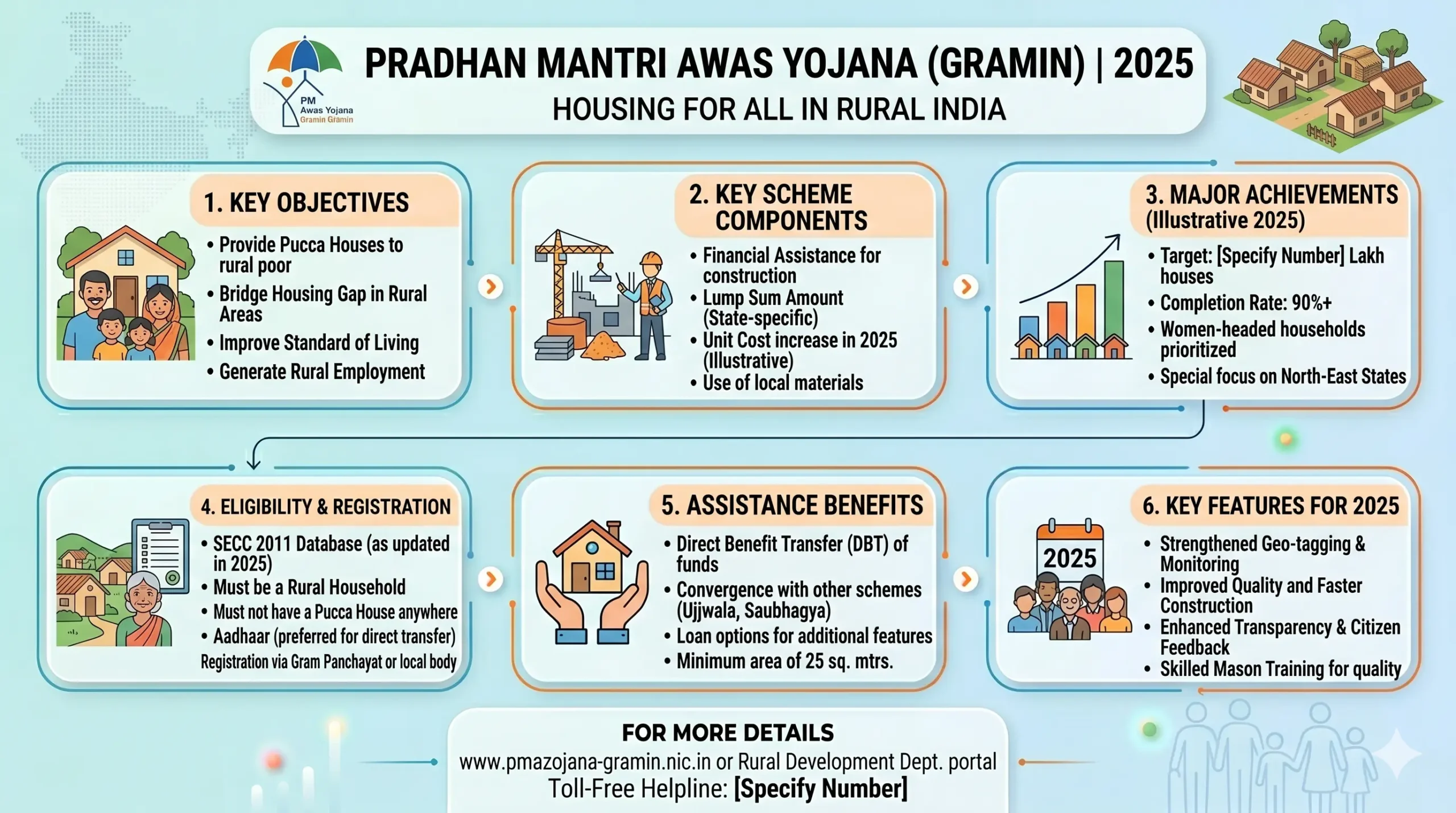
PMAY-G focuses on providing houses to rural poor and homeless families. Its objective is to provide a pucca house with basic amenities to all rural families who are homeless or living in kutcha or dilapidated houses. It is administered by the Ministry of Rural Development (MoRD). DD News
Unlike PMAY-Urban, which focuses on loans and subsidies, PMAY-G provides direct financial assistance — cash transferred straight into the beneficiary’s bank account — to build their own home. The beneficiary constructs the house themselves, with the government providing the funds in installments as construction progresses.
Key Features and Benefits of PM Awas Yojana Gramin
1. Financial Assistance for House Construction
Eligible beneficiaries receive ₹1.20 lakh in plain areas and ₹1.30 lakh in hilly, difficult, and IAP (Integrated Action Plan) districts. This is the core financial support for constructing the house. India Herald
2. Additional Toilet Grant
Every PMAY-G beneficiary also receives a grant of ₹12,000 from the Swachh Bharat Mission (Gramin) for constructing a toilet inside the house—ensuring every new home is built with sanitation facilities.
3. Basic Amenities Included
Houses are built with sanitation, LPG connection, electricity, and drinking water through coordination with other government schemes. Every PMAY-G house is thus linked to Swachh Bharat (toilet), Saubhagya (electricity), Ujjwala (LPG), and Jal Jeevan Mission (piped water)—creating a fully equipped home. India Herald
4. Minimum 25 Square Meters
The minimum size of a house under this scheme is 25 square meters (including a kitchen). This ensures adequate living space for the family. India Herald
5. Cost Sharing Between the Center and States
The cost is shared in a 60:40 ratio between the central and state governments in plain areas and 90:10 in northeastern and hilly states. This ensures that even poorer states can fund their housing targets. India Herald
6. Direct Bank Transfer via DBT
The financial assistance is transferred directly to the beneficiary’s bank account through DBT, ensuring transparency and eliminating middlemen. Payments are released in three to four installments, linked to construction progress. India Herald
7. Technology-Based Monitoring
Houses are geo-tagged using AwaasSoft and monitored via AwaasApp to ensure quality and timely construction. Beneficiaries must upload photographs of each construction stage through the app to receive the next installment. India Herald
Who Is Eligible for PM Awas Yojana Gramin?
Beneficiaries are selected based on data from the Socio-Economic and Caste Census (SECC) and verified by the Gram Sabha. The primary eligibility conditions include:
Families living in kutcha houses or without a proper home; households without an adult male member aged 16–59; households with disabled members and no able-bodied adult members; families without land or shelter; and SC/ST, minority, and BPL (Below Poverty Line) households. India Herald
Additionally, eligibility focuses on the most deprived, including SC/ST households, women-led families, and landless laborers. Wbgov
Who Is NOT Eligible?
Families are excluded from PMAY-G if they own:
- A motorised vehicle (car, tractor, etc.)
- A refrigerator or landline telephone
- Government employment or income tax-paying members
- 2.5 acres or more of irrigated land
Awaas+ 2024 Survey—Updated Beneficiary List
A fresh survey—Awaas+ 2024—has been conducted to identify additional eligible rural households who were missed in the original SECC 2011 data. The extension of the Awaas+ 2024 survey timeline was announced in June 2025 to identify additional eligible rural households. Google Translate
This new survey means that many families who were previously left out of the beneficiary list now have the opportunity to be included and receive housing benefits.
How to Check Your Name in the PM Awas Yojana Gramin Beneficiary List
- Visit the official PMAY-G portal: pmayg.nic.in
- Click on “Stakeholders” → “IAY/PMAYG Beneficiary”
- Enter your Registration Number—or search by name, state, district, block, and village
- Your beneficiary status and payment details will be displayed
Alternatively, visit your Gram Panchayat office—the beneficiary list is also displayed publicly at the panchayat for transparency.
How to Apply for PM Awas Yojana Gramin
PMAY-G applications are not directly filed by citizens—beneficiaries are selected from the SECC 2011 database and the new Awaas+ 2024 survey by the Gram Sabha and verified by state governments. However, if you believe you are eligible but not on the list, here is what you can do:
- Contact your Gram Pradhan or Panchayat Secretary—request to be included in the Awaas+ survey if you were missed
- Visit your Block Development Office (BDO) — submit a written application with documents proving your housing deprivation
- File a grievance on the PMAY-G portal at pmayg.nic.in → “Grievance” section
- Ensure your Aadhaar is linked to your bank account for seamless DBT transfers once approved
Documents Required
Aadhaar card for identity verification; ration card to confirm family details; bank account details for DBT; caste certificate for SC/ST/OBC beneficiaries; and income certificate. India Herald
Progress of PM Awas Yojana Gramin
The scale of achievement under PMAY-G is extraordinary:
- Over 2.95 crore houses have been completed under PMAY-G since 2016
- The 2025 list is particularly significant because it comes after fresh surveys, revised data checks, and renewed pressure on states to speed up rural housing delivery. newsoneair
- Progress is tracked via the AwaasSoft portal and Awaas app, ensuring real-time accountability. Scribd
- States like Uttar Pradesh, West Bengal, Madhya Pradesh, Rajasthan, and Odisha have been the largest beneficiaries in terms of houses sanctioned
Impact of PM Awas Yojana Gramin on Rural India
On the ground, the impact of PMAY-G houses is often immediate. Children gain safer spaces to study, women report improved privacy and security, and families are better protected during extreme weather. newsoneair
Beyond individual families, PMAY-G has:
- Boosted the rural construction economy—generating tens of crores of person-days of unskilled labour
- Connected homes to multiple welfare schemes simultaneously (toilet, electricity, gas, water)
- Empowered women — many PMAY-G houses are registered in the name of the woman of the household or jointly with the husband
- Reduced rural-to-urban migration by improving living conditions in villages
Frequently Asked Questions (FAQs)
Q1. Can a landless family apply for PMAY-G?
Yes. Landless families are among the priority categories under PMAY-G. If selected, the state government helps arrange land through other rural land distribution schemes.
Q2. In how many installments is the money released?
Typically three installments—one at the foundation level, one at the lintel level, and one at the roof level—verified via geo-tagged photographs uploaded through the AwaasApp.
Q3. Can I upgrade an existing kuchcha house under PMAY-G?
Yes. The scheme covers both new construction and upgradation of severely dilapidated kuchcha structures.
Q4. Is there a deadline to complete construction once approved?
Yes—beneficiaries are expected to complete construction within 12 to 18 months of receiving the first installment.
Q5. What is the official website for PMAY-G?
pmayg.nic.in and pmayg.dord.gov.in
Conclusion
The Pradhan Mantri Awas Yojana Gramin is not just a housing scheme—it is a declaration that every rural Indian deserves to live with dignity. By providing ₹1.20 to ₹1.30 lakh directly into the bank accounts of the most deprived rural families to build their own permanent homes—complete with toilets, electricity, gas, and water—PMAY-G has created a transformation in rural India that no development index can fully capture. Extended to 2029 with a target of two additional crore houses, the scheme is more relevant than ever.
If you are a rural family living in a kutcha or dilapidated structure, contact your Gram Panchayat today, ensure you are in the Awaas+ survey, and take the first step toward the home you deserve.

Rohanshi Mhatre aims to bridge the gap between government initiatives and citizens by delivering clear, reliable, and easy-to-follow information so that everyone can take advantage of available schemes.