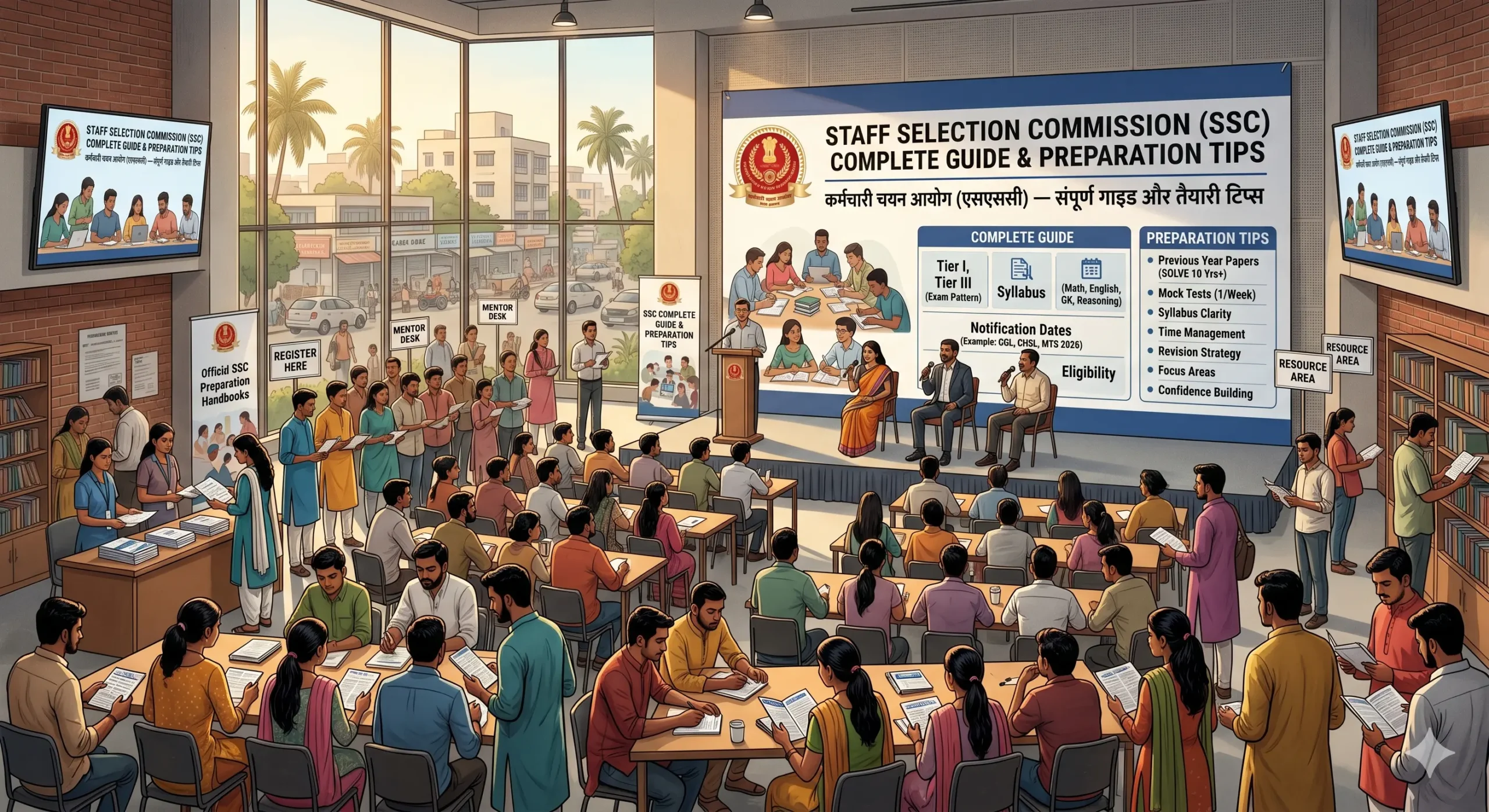
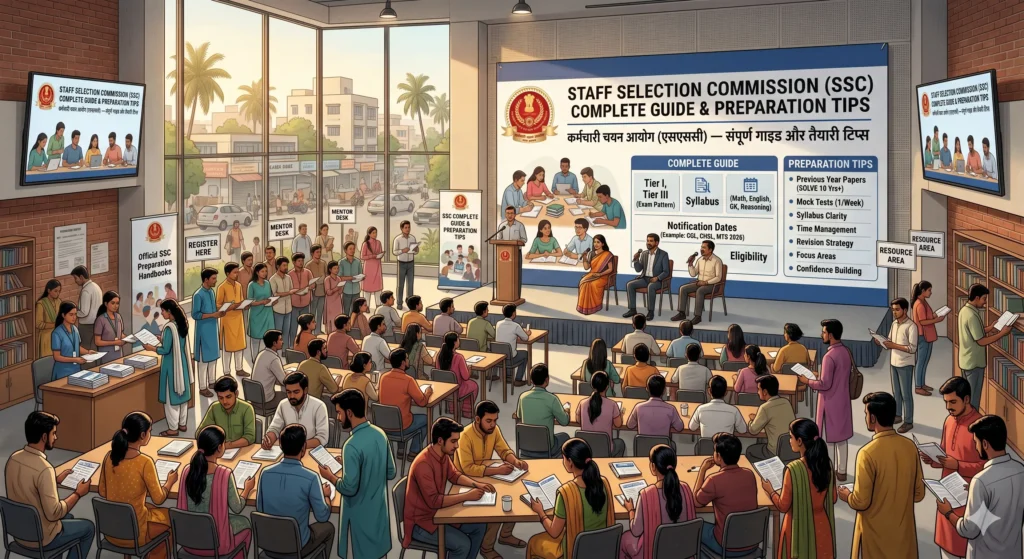
The Staff Selection Commission (SSC) is one of the most important government recruitment bodies in India. Established in 1975, SSC conducts examinations for recruitment to various posts in ministries, departments, and subordinate offices of the Government of India. Every year, millions of aspirants appear for SSC exams hoping to secure a stable, well-paying central government job. The most popular examinations conducted by SSC include the Combined Graduate Level (CGL), Combined Higher Secondary Level (CHSL), Multi-Tasking Staff (MTS), and the Stenographer Grade C & D examination.
SSC CGL is designed for graduate-level candidates and opens the door to prestigious posts such as income tax inspector, excise inspector, assistant section officer, sub-inspector in CBI, auditor, accountant, and statistical investigator. SSC CHSL is for Class 12 pass candidates and recruits for posts like Lower Division Clerk (LDC), Postal Assistant, Data Entry Operator (DEO), and Sorting Assistant. Both exams are conducted in computer-based mode and follow a multi-tier selection process.
The appeal of SSC exams lies in the combination of job security, attractive salary, allowances, promotion opportunities, and the respect that comes with central government employment. However, with competition intensifying each year—over 30 lakh candidates apply for CGL alone—casual preparation is no longer enough.
Table of Contents
Exam Structure and Pattern: Staff Selection Commission
SSC CGL follows a two-tier structure (after recent reforms). Tier 1 is a screening round with four sections: General Intelligence & Reasoning (25 questions, 50 marks), General Awareness (25 questions, 50 marks), Quantitative Aptitude (25 questions, 50 marks), and English Comprehension (25 questions, 50 marks). Total: 200 marks in 60 minutes. There is a negative marking of 0.50 marks per wrong answer.
Tier 2 is a comprehensive exam with separate papers for Mathematics, English Language and Comprehension, Statistics (for certain posts), and General Studies covering Finance and Economics (for AAO posts). Tier 2 is where the real battle for merit ranking is fought.
SSC CHSL follows a similar Tier 1 pattern but includes a descriptive Tier 2 paper—an essay (200–250 words) and a letter/application (150–200 words), conducted online and evaluated manually. The descriptive paper carries 100 marks and is often underestimated by aspirants.
SSC MTS has two papers—an objective computer-based test and a descriptive paper. The stenographer exam includes a skill test for shorthand speed after the written round.
Syllabus Breakdown: Staff Selection Commission
Quantitative Aptitude is arguably the most scoring but also the most time-consuming section. Key topics include the number system, simplification, percentages, ratio and proportion, profit & loss, simple and compound interest, time and work, time speed distance, algebra, geometry, trigonometry, mensuration, statistics, and data interpretation. Geometry and trigonometry carry heavy weight in CGL Tier 2 and require dedicated preparation.
General Intelligence & Reasoning is one of the more learnable sections. It covers analogy, classification, series (number, alphabet, and mixed), coding-decoding, blood relations, direction and distance, syllogism, matrix, word formation, Venn diagrams, and non-verbal reasoning, including paper folding, mirror images, and embedded figures.
English language tests grammar fundamentals and vocabulary. Important topics include spotting errors, filling in the blanks, synonyms and antonyms, spelling correction, idioms and phrases, one-word substitution, improvement of sentences, para jumbles, cloze tests, and reading comprehension.
General Awareness is the broadest section. It includes current affairs (last 6–12 months), history (ancient, medieval, modern), geography (Indian and world), Indian polity and constitution, economics, physics, chemistry, biology, computer awareness, and static GK covering sports, awards, books, important days, and government schemes.
Subject-Wise Preparation Strategy: Staff Selection Commission
Begin your preparation with an honest diagnostic. Take a full-length mock test before you study anything and identify where you lose the most marks. This sets your priority order.
For math, start with the chapters that appear most frequently: percentage, ratio, profit & loss, and time & work. Master shortcut techniques—SSC Maths demands speed, and traditional methods are too slow for a 36-second-per-question pace. R.S. Aggarwal’s Quantitative Aptitude and Rakesh Yadav’s class notes are widely trusted resources.
For reasoning, practice is the only strategy. Do at least 30–40 questions daily. Non-verbal reasoning, particularly the series and analogy of figures, requires visual pattern recognition that improves with repetition.
For English, read a good newspaper daily. Focus on vocabulary—learn 10–15 new words each day in context, not in isolation. Grammar rules for error spotting (subject-verb agreement, tenses, and prepositions) can be mastered from a compact grammar book like S.P. Bakshi’s Objective General English.
For general awareness, static GK must be studied from a reliable source like Lucent’s GK book. Current affairs must be covered daily—a 15-minute daily news review is far more effective than marathon GK cramming sessions before the exam.
Mock Tests and Time Management: Staff Selection Commission
Appearing for mock tests is not optional—it is the backbone of SSC preparation. Begin taking full-length timed mocks at least 2–3 months before the exam. After each mock, spend at least as much time reviewing it as you spent attempting it. Every wrong answer must be traced back to its cause: was it a knowledge gap, a calculation error, a misread question, or a time pressure mistake?
In the actual exam, the recommended order of attempting sections is reasoning first (fastest), then general awareness (pure recall), then English, and finally math (most time-intensive). Never attempt math first unless you are exceptionally strong in it.
Negative marking in SSC is 0.50 per wrong answer, which is less punishing than most exams. This means you should attempt all questions you have reasonable confidence about—a 60–70% confidence threshold for attempting is a sound rule.
Common Mistakes and How to Avoid Them
The most damaging mistake aspirants make is studying too many books. Pick two or three quality resources per subject and exhaust them thoroughly. Breadth of resources does not equal depth of preparation.
Another common error is neglecting revision. Covering the syllabus once is not preparation—it is exposure. Real preparation is revising the same material three or four times until it is truly internalized.
Many aspirants also ignore the Tier 2 descriptive paper until the last moment. Essay and letter writing require structured thinking and practice over weeks, not days. Start practicing at least 3–4 essays per month from the beginning of your preparation.
Finally, take your physical and mental health seriously. SSC preparation often stretches over 6–12 months. Build a sustainable daily routine with proper sleep, exercise, and rest.
Post-Selection Career: Staff Selection Commission
Once selected, SSC officers enjoy job security, a monthly salary ranging from ₹25,500 (MTS) to ₹150,000+ (AAO/Inspector posts) depending on the pay level, house rent allowance, travel allowance, medical facilities, and assured promotions. Many aspirants use their SSC job as a financial base while continuing to prepare for UPSC or State PSC examinations.

Amita Gavas believes in empowering students with the right knowledge and guidance so they can confidently prepare for exams and secure a stable government career.